

End-to-end testing verifies that a complete, business-critical journey works across the real boundaries of a system. Instead of proving one function or service in isolation, an E2E test follows an observable outcome through the client, APIs, data stores, asynchronous workers, and selected external dependencies.
The goal is confidence at integration boundaries—not maximum test count. A small, deliberate E2E suite should protect the journeys whose failure would be most visible or costly.
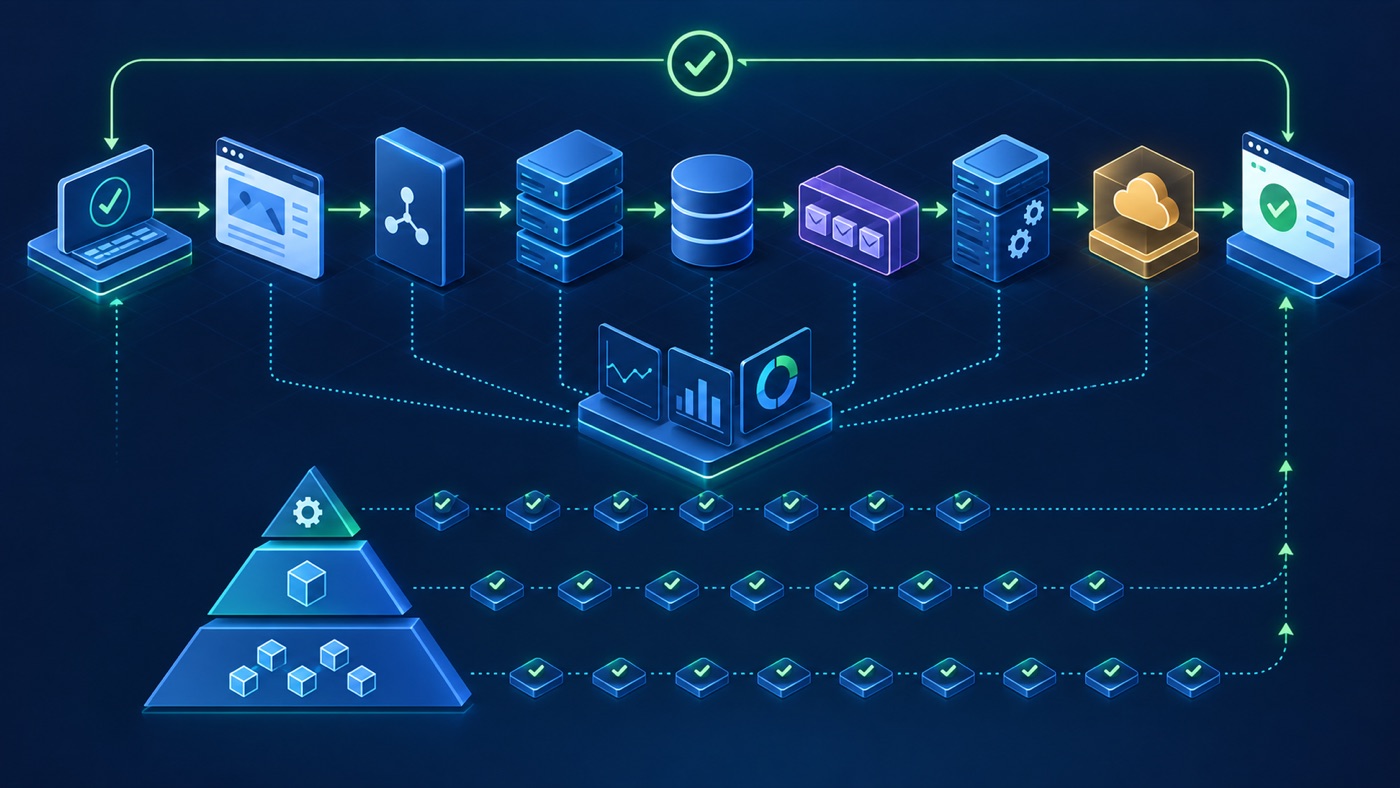
1. Define the Boundary Before Choosing the Tool
“E2E” can describe several valid scopes:
- Browser journey: a user interacts with the real UI and backend.
- API workflow: a client calls public APIs and verifies downstream state without a browser.
- Event-driven journey: a request produces messages, workers process them, and the test verifies an eventual result.
- Mobile journey: a real or simulated client crosses device, network, backend, and notification boundaries.
Write the boundary into the test plan. Otherwise teams may call a heavily mocked browser test “end to end” even though it never exercises authentication, persistence, or asynchronous processing.
2. Place E2E Tests in a Balanced Test Portfolio
| Test type | Primary question | Typical speed | Recommended volume |
|---|---|---|---|
| Unit | Does a small piece of logic behave correctly? | Milliseconds | Many |
| Component / integration | Do collaborating modules or infrastructure adapters work together? | Fast to moderate | Many |
| Contract | Can independently deployed producers and consumers still communicate? | Fast | Focused by boundary |
| End to end | Does the complete critical journey produce the required outcome? | Slowest | Few and high value |
If every behavior is tested through the browser, feedback becomes slow and failures become hard to localize. Move business-rule permutations into unit or service tests; reserve E2E coverage for integration risk and critical user outcomes.
3. Select Journeys by Risk
Start with workflows that combine high business impact and high integration complexity:
- Sign-in, authorization, and session renewal.
- Checkout, payment authorization, refund, and receipt delivery.
- Account creation and required verification.
- Data import, background processing, and final status.
- A deployment smoke test for the application’s primary read and write paths.
For each journey, define the initial state, triggering action, observable result, timeout budget, cleanup policy, and evidence captured on failure.
4. Design for Isolation and Determinism
Most flaky E2E tests are symptoms of uncontrolled state or timing. Reliable suites follow a few strict rules:
- Create unique test data and never depend on execution order.
- Authenticate through supported setup APIs when login itself is not under test.
- Wait for observable conditions rather than sleeping for a fixed duration.
- Use stable user-facing roles, labels, or dedicated test identifiers instead of fragile CSS structure.
- Freeze or explicitly control time, randomness, and feature flags when they affect the scenario.
- Clean up through idempotent APIs, TTL-based test records, or disposable environments.
import { test, expect } from '@playwright/test';

test('customer completes checkout', async ({ page, request }) => {
  const seed = await request.post('/test-support/orders', {
    data: { inventory: 'available', paymentMode: 'approved' }
  });
  const { orderId } = await seed.json();

  await page.goto('/orders/' + orderId);
  await page.getByRole('button', { name: 'Pay now' }).click();

  await expect(page.getByRole('status'))
    .toHaveText('Payment confirmed');
  await expect.poll(async () => {
    const response = await request.get('/api/orders/' + orderId);
    return (await response.json()).status;
  }).toBe('PAID');
});
The example verifies both the user-visible result and durable backend state. In a real system, the support endpoint must be isolated from production and protected by environment-level access control.
5. Test Asynchronous Workflows Explicitly
Queues and background workers make fixed sleeps especially unreliable. Poll a stable read model or consume a test-visible event with a deadline. Record correlation IDs so a failed run can connect browser traces, API logs, queue messages, and worker spans.
trigger action
  → capture correlation ID
  → poll observable state with bounded backoff
  → verify terminal business outcome
  → collect traces and clean up
A timeout should report the last observed state and relevant identifiers. “Timed out after 30 seconds” is not enough evidence for diagnosis.
6. Handle External Dependencies Deliberately
Calling every real third party from every pull request is usually slow, expensive, and unreliable. Use layers:
- Contract tests validate request and response compatibility.
- A high-fidelity simulator covers error modes and deterministic CI execution.
- A small scheduled or pre-release suite validates the provider sandbox.
- Production synthetic checks confirm the live integration without mutating real customer data.
Do not mock away the exact boundary the scenario intends to test. If payment-provider behavior is the risk, the test needs either the provider sandbox or a simulator whose contract is independently verified.
7. Build a Fast CI Feedback Strategy
| Pipeline stage | E2E scope | Purpose |
|---|---|---|
| Pull request | Small critical-path smoke suite | Block obvious integration regressions quickly |
| Post-merge | Broader parallel suite | Exercise more journeys against an integrated revision |
| Pre-release | Release-critical and provider-sandbox scenarios | Validate the exact artifact before promotion |
| Production | Non-destructive synthetic checks | Verify availability and core user outcomes continuously |
Shard only tests that are isolated. Cache dependencies, reuse immutable build artifacts, and provision environments predictably. A green run should identify the application revision, configuration version, test-data seed, and dependency endpoints used.
8. Treat Retries as Evidence, Not a Cure
A retry can distinguish an intermittent failure from a deterministic regression, but it must not erase the original failure. Track first-attempt pass rate, retry pass rate, duration, and failure category. Quarantine only with an owner, issue, and expiration date.
Useful failure artifacts include:
- Browser trace, screenshot, console output, and network log.
- Server logs and distributed traces filtered by correlation ID.
- Request and response metadata with secrets redacted.
- Container and environment health.
- Test seed, feature flags, and deployed artifact digest.
9. Separate Product Failures From Test Failures
Classify every failure into one of four buckets:
- Product regression: the system produced the wrong outcome.
- Environment failure: infrastructure or provisioning was unhealthy.
- Test defect: selectors, assertions, data, or timing were wrong.
- Dependency failure: an external system violated availability or contract expectations.
This classification turns flakiness into engineering work. Without it, teams either ignore red builds or spend product-development time chasing undifferentiated noise.
10. Ownership and Review Checklist
- Each journey has a business owner and an engineering owner.
- The test states what is real, simulated, and bypassed.
- Data setup and cleanup are isolated and idempotent.
- Assertions verify outcomes rather than implementation details.
- Timeouts are bounded and produce diagnostic context.
- Parallel execution cannot create cross-test interference.
- Retries preserve first-failure evidence.
- Flaky tests have owners, deadlines, and visible metrics.
Conclusion
Effective E2E testing is a thin layer of high-value journeys supported by strong lower-level tests. The suite should cross the boundaries that matter, verify observable business outcomes, run against controlled state, and provide enough telemetry to diagnose failure quickly. When those properties are present, E2E tests become release evidence instead of pipeline noise.
Comments
Loading comments…