

Reliable GitHub operations are not a collection of isolated commands. They are a controlled delivery system that moves a change from an idea to production while preserving reviewability, traceability, and a clear recovery path.
This guide presents a production-oriented operating model for GitHub repositories. It connects local Git practices with pull requests, protected branches, required checks, merge queues, GitHub Actions environments, releases, and incident recovery.
1. The GitHub Operations Lifecycle
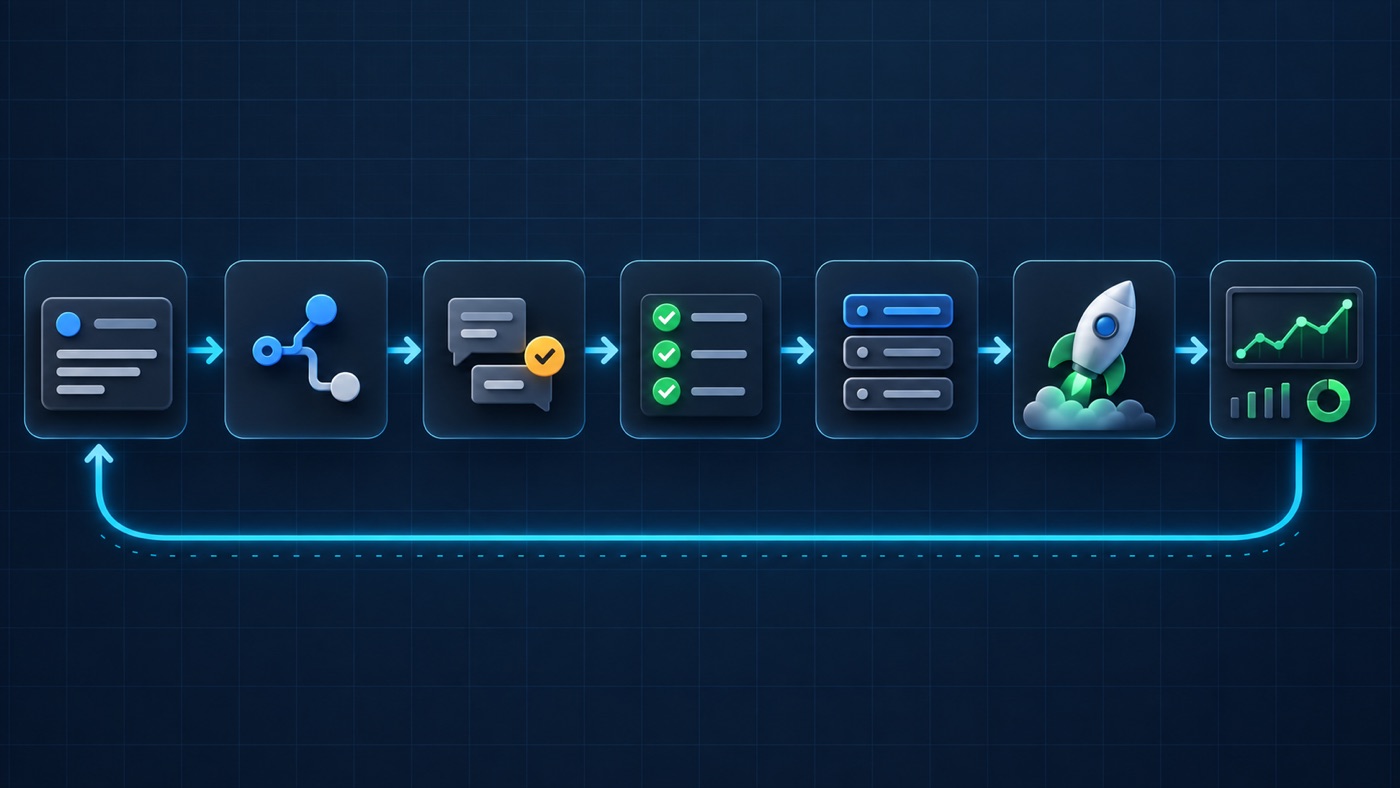
A healthy repository follows an explicit lifecycle:
Issue or change request
  → short-lived branch
  → focused commits
  → pull request
  → automated checks and peer review
  → controlled merge
  → deployment
  → verification and observability
  → release record or rollback
Each stage has a distinct responsibility. Git records the history; GitHub coordinates collaboration and policy; CI validates the change; CD moves an approved revision into an environment; observability determines whether that revision behaves correctly after deployment.
2. Establish Repository Policy Before Writing Code
Operational consistency begins with repository-level rules rather than individual memory. Protect the default branch and encode the minimum acceptable path to production.
- Require changes to enter through pull requests.
- Require at least one independent approval for production code.
- Dismiss stale approvals or require approval of the most recent reviewable push when the risk justifies it.
- Require named status checks for build, tests, linting, security, and migration validation.
- Require conversations to be resolved before merging.
- Restrict force pushes and branch deletion on protected branches.
- Use CODEOWNERS for components that need domain-specific review.
- Apply the same rules to administrators unless an emergency process explicitly permits a documented bypass.
GitHub supports both branch protection rules and repository rulesets. For larger organizations, rulesets are generally easier to layer, audit, and apply across repositories. Whichever mechanism is selected, avoid overlapping rules that produce ambiguous behavior.
Required Checks Must Be Stable
A required check is an API contract between repository policy and CI. Give every required job a unique, stable name. Renaming or conditionally omitting a required job can leave a pull request blocked even when the underlying code is valid.
name: pull-request

on:
  pull_request:
    branches: [main]

permissions:
  contents: read

jobs:
  verify:
    name: verify
    runs-on: ubuntu-latest
    steps:
      - uses: actions/checkout@v4
      - run: ./gradlew test
      - run: ./gradlew check
Keep workflow permissions at the minimum needed by the job. Separate untrusted pull-request validation from privileged release or deployment workflows.
3. Start Work From a Known Base
Before creating a branch, synchronize remote references and verify the local state:
git status
git fetch --prune origin
git switch main
git pull --ff-only
git switch -c feat/payment-retry-policy
git pull --ff-only prevents an accidental local merge commit when the local default branch has diverged. A short-lived branch should represent one coherent change and should be safe to delete after integration.
Commit for Reviewability
A useful commit is small enough to review, complete enough to test, and named for intent rather than implementation noise.
git add src/main/java/com/example/payment/RetryPolicy.java
git add src/test/java/com/example/payment/RetryPolicyTest.java
git commit -m "feat(payment): add bounded retry policy"
Stage reviewed paths explicitly. Avoid using git add . as a reflex because it can include generated files, local configuration, or unrelated edits.
4. Open a Pull Request as an Operational Change Record
A pull request is more than a request to merge. It should explain the production effect of the change and give reviewers enough evidence to evaluate it.
A strong pull request description answers:
- Problem: What user or system failure are we addressing?
- Approach: What changed, and why was this design selected?
- Risk: What could regress, and what is the blast radius?
- Validation: Which automated and manual checks were performed?
- Operations: Are there migrations, flags, dashboards, alerts, or runbooks?
- Rollback: How can the change be disabled or reverted?
git push -u origin feat/payment-retry-policy
gh pr create   --base main   --title "feat(payment): add bounded retry policy"   --body-file .github/pull_request_template.md
Keep draft pull requests for early collaboration and mark them ready only when the change is reviewable. Link the pull request to its issue so GitHub can preserve the relationship between intent, implementation, and completion.
5. Review the Change, Not Just the Diff
Senior-level review evaluates behavior and operational consequences as well as syntax. Reviewers should examine:
- Correctness under normal, failure, retry, and concurrency paths.
- Backward compatibility for APIs, events, schemas, and stored data.
- Authentication, authorization, secret handling, and data exposure.
- Idempotency, timeout, retry, and duplicate-delivery behavior.
- Performance, capacity, and cost impact.
- Metrics, logs, traces, alert thresholds, and recovery instructions.
- Whether tests verify behavior instead of implementation details.
Request changes for blocking issues, comment for discussion, and approve only the latest reviewable state. When new commits materially change the design, previous approval should be reconsidered.
6. Choose a Merge Strategy Deliberately
| Strategy | Result | Use when |
|---|---|---|
| Merge commit | Preserves every commit and records an explicit merge point | The branch history and grouping are meaningful |
| Squash and merge | Combines the pull request into one commit on the base branch | The pull request represents one logical change |
| Rebase and merge | Replays commits onto the base branch without a merge commit | Each commit is intentionally curated and linear history is required |
Squashing combines commit changes, not merely commit messages. GitHub's rebase-and-merge behavior creates new commit SHAs, so teams should not assume it preserves commit identity.
For most product repositories, squash merging is a practical default because it maps one reviewed pull request to one revertable mainline commit. Merge commits are valuable for long-running or semantically meaningful branches. Rebase merging is strongest when the branch already contains a carefully designed commit series.
Use a Merge Queue Under High Concurrency
When many pull requests target the same protected branch, a pull request can pass against an earlier base and fail after another change lands. A merge queue serializes integration, retests the queued result, and reduces broken-main incidents without forcing every author to update manually after each merge.
7. Resolve Conflicts Without Losing Intent
Conflict markers show textual disagreement; they do not identify the correct business behavior. Begin by inspecting the graph and the affected files:
git fetch origin
git status
git log --oneline --graph --decorate --all
git diff
For a private feature branch, rebasing onto the latest default branch can make the pull request easier to review:
git rebase origin/main
# Resolve one conflicted commit
git add <reviewed-path>
git rebase --continue
Run relevant tests after each logical resolution. Use git rebase --abort if the operation should be abandoned. If a rewritten private branch must be updated remotely and repository policy permits it, use git push --force-with-lease, never an unconditional force push.
For shared branches, prefer merging rather than rewriting history:
git merge origin/main
# Resolve and test
git add <reviewed-path>
git merge --continue
Use git merge --abort when the merge should not continue. Start merge and rebase operations from a clean working tree so abort behavior remains predictable.
8. Separate CI From Deployment Authority
Pull-request workflows should validate code without receiving production credentials. Deployment workflows should run only from trusted refs and should use GitHub environments to control access to secrets and deployment targets.
name: deploy-production

on:
  workflow_dispatch:
  push:
    tags:
      - "v*"

permissions:
  contents: read
  id-token: write

concurrency:
  group: production
  cancel-in-progress: false

jobs:
  deploy:
    environment: production
    runs-on: ubuntu-latest
    steps:
      - uses: actions/checkout@v4
      - run: ./scripts/deploy.sh
Environment protection rules can require reviewers, restrict deployment branches, add wait timers, or invoke custom protection rules. Environment secrets are not made available to a job until the configured protection rules pass.
Use concurrency to prevent overlapping production deployments. Prefer short-lived cloud credentials obtained through OpenID Connect over long-lived provider keys when the target platform supports it.
9. Treat Releases as Immutable Delivery Records
A release should identify exactly what was delivered. Tag the tested commit, generate or curate release notes, attach required artifacts, and retain links to deployment and observability evidence.
gh release create v2.4.0 --generate-notes --verify-tagFor repositories using immutable releases, create a draft first, attach and verify all assets, and publish only after the release is complete. After publication, the release becomes a durable reference for support, incident response, and rollback decisions.
10. Verify Production After the Workflow Turns Green
A successful workflow confirms that automation completed; it does not prove that users are receiving correct behavior. Every production deployment should have an explicit verification stage:
- Confirm the deployed revision or image digest.
- Run smoke tests against the production endpoint.
- Compare error rate, latency, saturation, and business metrics with the previous baseline.
- Check migration completion and consumer lag when applicable.
- Record the release, deployment, dashboard, and incident links in one traceable location.
Progressive delivery, feature flags, and canary analysis reduce blast radius, but they still need an owner and a defined rollback threshold.
11. Roll Back by Reverting State, Not Rewriting History
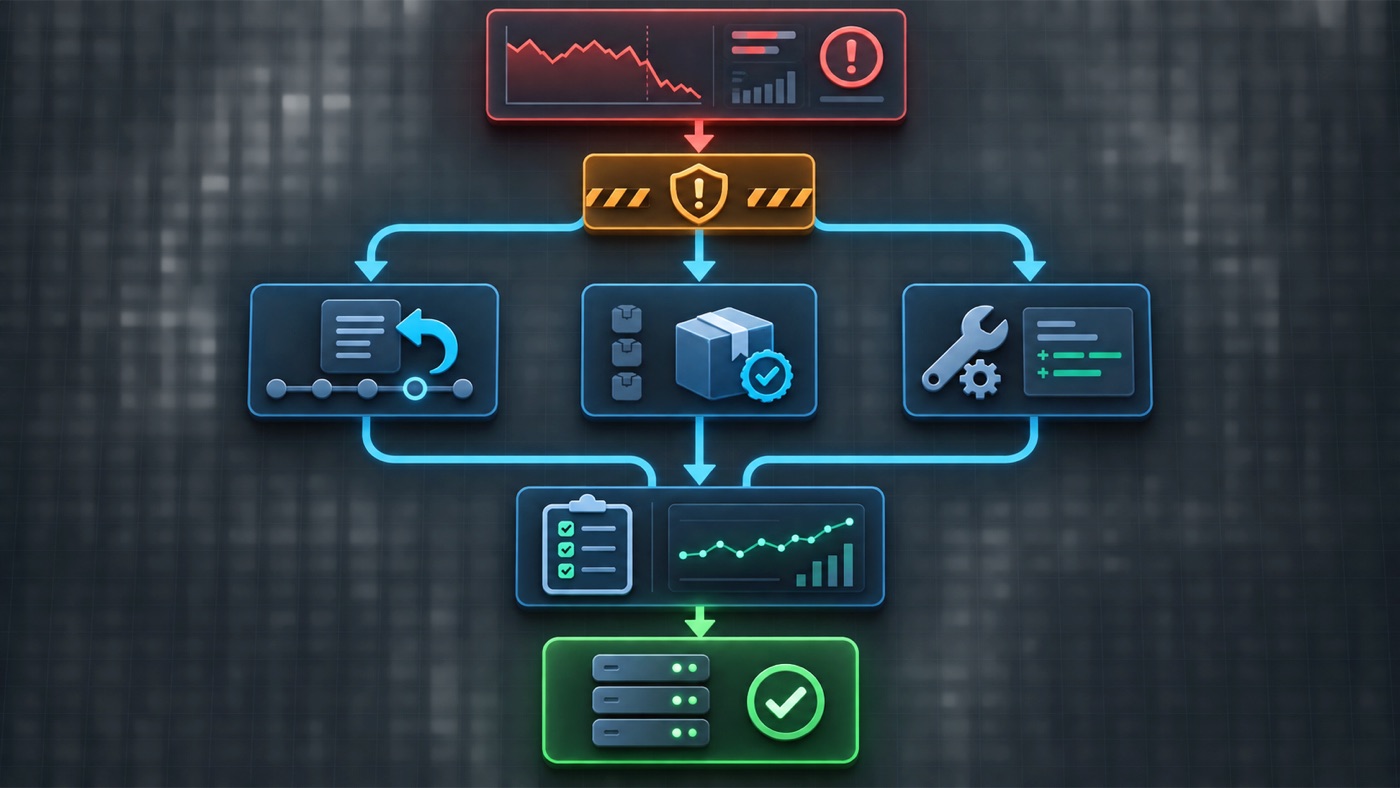
Do not repair a broken protected branch by force-pushing its history. Create a new change that restores a known-good state:
gh pr revert <pull-request-number>
# Or create a local revert commit
git revert <merge-or-squash-commit>
git push origin HEAD
gh pr create --base main --title "revert: disable payment retry policy"
If the failure is deployment-specific and the source revision is still valid, redeploy the last known-good immutable artifact instead of rebuilding an old commit. A rebuild may resolve different dependencies and no longer represent the artifact that previously ran successfully.
Emergency Changes Still Need Evidence
A break-glass path may reduce normal approval requirements, but it should increase auditability. Record the incident, actor, reason, exact revision, validation, and follow-up work. Restore normal branch and deployment protections immediately after the emergency.
12. A Practical Operating Checklist
Before Opening the Pull Request
- The branch is current enough to validate the intended integration.
- Commits contain no secrets or unrelated generated files.
- Tests, linting, and local validation pass.
- The pull request explains risk, rollout, observability, and rollback.
Before Merging
- Required reviews and status checks apply to the latest commit.
- Conversations are resolved and ownership requirements are satisfied.
- Schema and API compatibility have been reviewed.
- The selected merge method matches repository history policy.
Before and After Deployment
- The deployment references an immutable commit, tag, or artifact digest.
- Environment protections and concurrency controls are active.
- Smoke tests and production metrics are checked.
- A rollback target and responsible operator are known.
Conclusion
Professional GitHub operations turn repository activity into a governed delivery process. Short-lived branches and focused pull requests improve reviewability; protected branches and required checks make policy executable; merge queues protect a busy mainline; environments and releases create controlled deployment records; and revert-based recovery preserves an auditable history.
The goal is not a perfectly linear graph. The goal is a system in which every production change can be understood, verified, and safely reversed.
Comments
Loading comments…